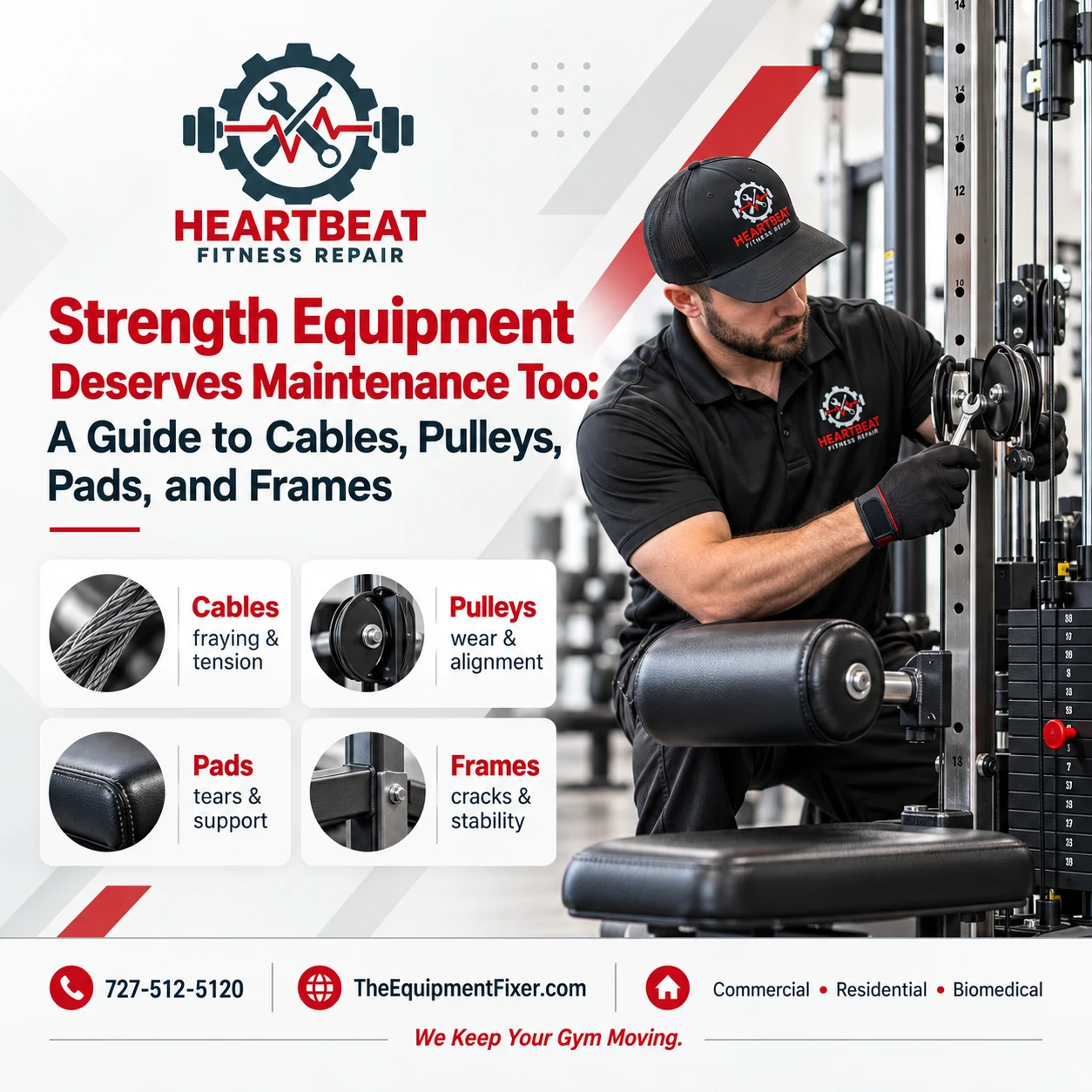
Strength Equipment Deserves Maintenance Too: A Guide to Cables, Pulleys, Pads, and Frames
Strength equipment can fail more quietly. A machine may still complete its basic motion while a cable is beginning to fray, a pulley bearing is wearing out, or a frame bolt is loosening. Because the equipment “still works,” maintenance is easy to postpone.
Share: Facebook · LinkedIn · X

Strength equipment often gets less attention than treadmills, bikes, and ellipticals. Cardio machines announce problems quickly: a belt slips, a console goes dark, or a motor starts making an alarming sound.
That is exactly why preventive care matters. A small issue can become a sudden cable snap, unstable bench, damaged weight stack, or costly shutdown. Whether you manage a commercial facility or maintain a home gym, a consistent inspection routine protects users, reduces downtime, and extends the useful life of your equipment.
Why strength equipment is easy to neglect
Strength machines are built to feel solid. Their frames are heavy, their movements are controlled, and many of their problems develop behind shrouds or inside mechanical assemblies.
But “working” does not always mean “safe.”
A cable can carry weight while its outer coating is cracked. A pulley can turn while its bearing grinds. A rack can appear stable while fasteners gradually loosen. Upholstery can look acceptable from a distance while split seams expose foam that traps moisture and bacteria.
In a commercial gym, high usage, sweat, dust, repeated adjustments, and occasional misuse accelerate wear. In a home gym, equipment may be used less often but inspected even less frequently. Both environments benefit from the same principle: find developing problems before they become safety events.
Cables: the most important safety inspection
Cables are among the highest-risk components on selectorized machines, cable crossovers, functional trainers, and multi-station equipment. They experience repeated bending, tension, rubbing, and loading every time a user moves a handle.
Inspect the entire cable, not just the section that is easiest to see. Look for:
- Fraying or broken wire strands
- Kinks, twists, and flat spots
- Cracked, peeling, or damaged coating
- Corrosion or discoloration
- Cable rubbing against a frame, pulley, or shroud
- Loose end fittings, crimps, thimbles, or ball stops
- Unusual slack, jumping, or uneven tension
A cable snap is the major safety event everyone wants to prevent. Waiting until a cable visibly fails is not a maintenance strategy. Replace a cable at the first meaningful sign of damage and follow the equipment manufacturer’s specifications for the correct replacement.
Stop line: cables
Never use a machine with a frayed, kinked, corroded, flattened, or exposed cable. Park it out of service, attach a clear tag, and keep it unavailable until the cable has been properly replaced and the system tested.
Pulleys and bearings need attention, but not excessive lubrication
A pulley should rotate smoothly, track correctly, and remain securely mounted. During an inspection, listen for squealing, grinding, scraping, clicking, or changes in resistance. Check for side-to-side wobble, misalignment, damaged brackets, and loose mounting hardware.
Bearings and pulley assemblies do not improve simply because more lubricant is added. Over-lubrication can attract dust and create a paste that accelerates wear. Some sealed bearings should not be lubricated at all. Use only the product and method recommended by the manufacturer.
Guide rods on weight stacks may require cleaning and an appropriate silicone-based lubricant, but the correct service interval varies. If plates stick, jerk, scrape, or travel unevenly, the issue may involve dirty rods, bent rods, misaligned plates, cable tension, or a damaged pulley, not just a lack of lubricant.
Upholstery and pads affect hygiene and safety
Seats, benches, back pads, thigh pads, and roller pads receive constant contact with sweat, clothing, and body oils. Clean them regularly with a manufacturer-approved product, applying cleaner to a cloth rather than saturating the upholstery.
During a weekly inspection, check for:
- Cracked vinyl
- Split seams
- Torn corners
- Loose covers
- Exposed or deteriorating foam
- Sharp edges or protruding fasteners
- Pads that shift during use
Damaged upholstery is more than a cosmetic concern. Tears can collect moisture and bacteria, while exposed foam can deteriorate and create an uncomfortable or unsafe surface. Minor damage may be repairable. When the cover is extensively cracked or the foam has lost its shape, professional re-upholstery can restore the pad without replacing the entire machine.
Heartbeat Fitness Repair provides upholstery and pad replacement for equipment that needs a more durable solution.
Frames, welds, bolts, and fasteners
A strong frame still depends on properly tightened hardware and a stable floor. Inspect machine frames, racks, benches, plate trees, and storage units for cracks, dents, corrosion, damaged welds, and unusual movement.
Pay particular attention to:
- Rack uprights and crossmembers
- J-hooks, spotter arms, and safety catches
- Bench adjustment mechanisms
- Foot plates and machine bases
- Pulley brackets and cable attachment points
- Anchors and floor-level hardware
- Bolts that loosen because of vibration or repeated use
A wobbling bench or rack should not remain in service while someone “keeps an eye on it.” Check the floor first: uneven flooring, worn rubber tiles, or shifting anchors can create instability even when the frame itself is sound.
Stop line: frames and safety hardware
Never modify, drill, or re-weld a structural frame as a casual repair. Never remove shrouds, safety stops, catches, or guards to keep a machine operating. If structural integrity or safety hardware is in question, tag the equipment out of service and call a qualified professional.
Weight stacks, selector pins, and shrouds
Selectorized machines should move smoothly through their full range. Inspect the weight stack for plates that rub, stick, tilt, or fail to return properly. Guide rods should be straight and free of excessive scoring. Selector pins should be present, straight, fully inserted, and attached to their lanyards when designed that way.
Also verify that protective shrouds remain secure and intact. Shrouds help keep users away from pinch points and moving components. Missing or damaged covers should be corrected before the machine returns to service.
A missing selector pin is not a minor inconvenience. Using an improvised pin, loose hardware, or an incorrectly sized replacement can allow the selected load to disengage unexpectedly.
Belts and chains on plate-loaded and older equipment
Not every strength machine uses a modern cable system. Plate-loaded machines and older equipment may rely on belts, chains, sprockets, or linkages.
Look for:
- Belt cracking, glazing, stretching, or slipping
- Chain rust, stiff links, or excessive slack
- Worn sprocket teeth
- Loose or missing retaining hardware
- Binding during the machine’s range of motion
- Sudden changes in resistance
Do not assume a chain needs oil simply because it makes noise. The correct lubricant and adjustment depend on the equipment design. Excessive slack or damaged components require proper evaluation rather than a quick spray and continued use.
The commonly ignored zones
Preventive maintenance should include more than selectorized machines. Frequently overlooked equipment includes:
- Flat and adjustable benches
- Power racks and squat stands
- Smith machines
- Cable crossovers
- Functional trainers
- Plate-loaded presses and rows
- Dumbbell racks and plate trees
- Floor anchors and equipment mats
Smith machine guide rods, bar travel, catches, and counterbalance systems deserve particular attention. Cable crossovers need alignment checks across both sides, especially when multiple users adjust pulley heights throughout the day. Functional trainers should be inspected at every cable position because wear can develop at one angle or travel path before another.
Mats and floor anchoring also matter. A mat that curls, slides, or separates can create a trip hazard and may allow equipment to shift under load.
A practical inspection cadence
A simple schedule helps turn maintenance into a habit.
Weekly owner or staff checks
- Wipe upholstery, handles, grips, and adjustment points
- Visually inspect cables, attachments, and selector pins
- Check benches, racks, and machines for wobble
- Listen for new squeaks, grinding, clicking, or uneven resistance
- Confirm safety catches, shrouds, and guards are present
- Record defects and remove questionable equipment from use
Monthly checks
- Inspect cable paths and end fittings more closely
- Check frame bolts, rack hardware, bench mechanisms, and anchors
- Review pulley alignment and weight stack movement
- Examine belts, chains, guide rods, and attachment points
- Confirm warning labels and load information remain visible
- Review maintenance records for repeated complaints or repairs
Professional service
A qualified technician should perform periodic preventive maintenance based on equipment type, age, usage, and manufacturer guidance. Professional service is especially valuable for cable replacement, pulley and bearing diagnosis, structural concerns, weight stack alignment, internal mechanisms, and equipment that has experienced a failure.
Safety stop lines for troubleshooting
Before any hands-on troubleshooting:
- Unplug the equipment first if it has electrical components or motorized features.
- Never open a controller or electrical enclosure unless you are qualified to do so.
- Never bypass a safety device, switch, guard, stop, or interlock.
- Never use equipment with a frayed cable or compromised frame.
- Park equipment out of service and tag it clearly until the problem is corrected.
When it is time to call a professional
Contact a fitness equipment repair professional when you notice a damaged cable, repeated pulley noise, a bent guide rod, a loose or shifting frame, cracked welds, recurring belt or chain problems, a weight stack that binds, or safety hardware that will not lock securely.
Professional preventive maintenance plans can make these inspections predictable instead of reactive. For commercial facilities, that means less disruption for members and staff. For home gym owners, it means more confidence in every training session.
Heartbeat Fitness Repair has completed more than 5,000 equipment repairs, delivered over 19,000 hours of on-site expertise, and served more than 1,000 customers. From residential gym equipment repair to commercial fitness equipment repair, our goal is simple: help equipment last longer, perform better, and remain ready for the people who depend on it.
Strength equipment supports progress in every kind of training. With the right maintenance mindset, it can continue supporting that progress for years to come.
Frequently Asked Questions
- When should a strength machine with cable damage be taken out of service?
- Never use a machine with a frayed, kinked, corroded, flattened, or exposed cable. Park it out of service, attach a clear tag, and keep it unavailable until the cable has been properly replaced and the system tested.
- Should pulley bearings always be lubricated?
- Bearings and pulley assemblies do not improve simply because more lubricant is added. Over-lubrication can attract dust and create a paste that accelerates wear. Some sealed bearings should not be lubricated at all. Use only the product and method recommended by the manufacturer.
- When should strength equipment be inspected by a professional?
- Contact a fitness equipment repair professional when you notice a damaged cable, repeated pulley noise, a bent guide rod, a loose or shifting frame, cracked welds, recurring belt or chain problems, a weight stack that binds, or safety hardware that will not lock securely.
Frequently Asked Questions
- When should a strength machine with cable damage be taken out of service?
- Never use a machine with a frayed, kinked, corroded, flattened, or exposed cable. Park it out of service, attach a clear tag, and keep it unavailable until the cable has been properly replaced and the system tested.
- Should pulley bearings always be lubricated?
- Bearings and pulley assemblies do not improve simply because more lubricant is added. Over-lubrication can attract dust and create a paste that accelerates wear. Some sealed bearings should not be lubricated at all. Use only the product and method recommended by the manufacturer.
- When should strength equipment be inspected by a professional?
- Contact a fitness equipment repair professional when you notice a damaged cable, repeated pulley noise, a bent guide rod, a loose or shifting frame, cracked welds, recurring belt or chain problems, a weight stack that binds, or safety hardware that will not lock securely.
Related Services in Tampa Bay
- Strength Equipment Repair in Tampa, FL
- Strength Equipment Repair in Clearwater, FL
- Strength Equipment Repair in St. Petersburg, FL
- Strength Equipment Repair in Brandon, FL
- Strength Equipment Repair in Sarasota, FL
- All Strength Equipment Repair Service Areas
- Schedule a Repair — Same-Week Appointments Available
Strength Equipment Service in Tampa Bay
- Strength Equipment Repair in Tampa
- Strength Equipment Repair in Clearwater
- Strength Equipment Repair in St. Petersburg
- Preventive Maintenance
- Upholstery & Pad Replacement
Need Strength Equipment Maintenance?
Call Heartbeat Fitness Repair at 727-512-5120 or schedule service.
Written Quote Before Any Work Begins
Prices shown are starting estimates — actual cost varies by brand, model, and parts availability. We always provide an exact written quote before we touch your machine, so there are no surprises on the invoice. We’re also an authorized warranty repair provider for many major manufacturers. Call 727-512-5120 for pricing on your specific unit.