Do You Really Need Preventive Maintenance for Your Home Gym? Here's the Truth
The honest answer: not always. The right level of care depends on the equipment, how often it is used, and what its manufacturer recommends. Regular upkeep is worthwhile; a professional visit makes the most sense when it addresses a specific need, such as heavier use, complex equipment, or warning signs you cannot safely resolve yourself.
Share: Facebook · LinkedIn · X
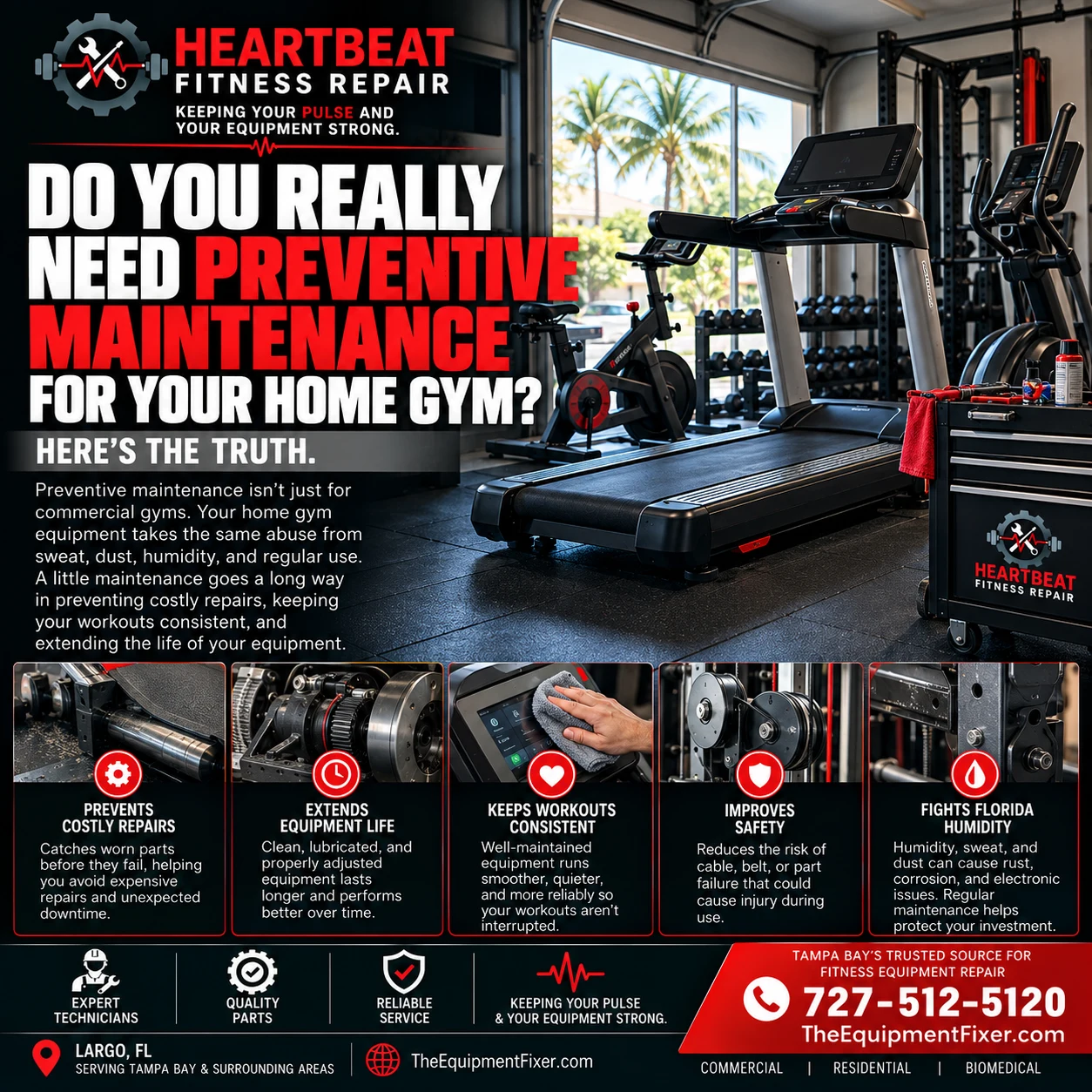
If you own a treadmill, exercise bike, elliptical, or strength machine, preventive maintenance can help keep it safe, dependable, and ready when you are. But does every home gym need a professional service visit on a fixed schedule?
What preventive maintenance actually means
Preventive maintenance is planned care carried out before a machine breaks down. It may include cleaning, inspection, lubrication, adjustments, safety checks, and identifying wear that could become a larger problem if left unattended.
It is different from repair. Maintenance looks for early signs of trouble; repair responds to a known fault or failure. Neither approach can guarantee that a part will never wear out, but a consistent routine can help you notice changes before they interrupt your workouts, or become a safety concern.
The manufacturer’s manual should guide the schedule and procedures. Equipment designs, lubricants, and recommended service intervals vary, so one generic treadmill routine will not fit every model. For instance, treadmill manufacturer guidance and a Spirit Fitness owner’s manual give model-specific care instructions. Follow the manual for your machine rather than assuming it needs a particular lubricant or service interval.
What can happen if you skip it?
A machine rarely fails just because you missed one cleaning. The bigger concern is that small, visible changes can go unnoticed: a treadmill belt that begins to drift, a dry deck, loose hardware, a fraying cable, or a pulley that no longer moves smoothly.
On a treadmill, excess friction between the belt and deck can put additional strain on drive components. Dust buildup, sweat, or neglected fasteners can also contribute to wear. On strength equipment, a damaged cable or worn pulley may affect how smoothly a load moves. These issues do not always mean a machine is about to fail, but they are reasons to inspect it and consult the manual, or a technician, rather than ignore the change.
Even if you avoid a breakdown, using equipment that feels unstable, sounds unusual, or fails to stop as expected can put your safety at risk. A maintenance routine is not about worrying over every sound; it is about noticing meaningful changes and responding appropriately.
Planned care versus reactive repairs
Reactive repairs can feel easier to put off: wait until something stops working, then arrange service. The trade-off is that a failure may interrupt your routine and leave you with fewer options about when to address it. If a worn or misaligned component has affected other parts, the repair may also involve more than the original issue.
Planned maintenance has a different purpose: inspect and care for equipment while it is still operating, and identify concerns early. That does not mean every service visit will prevent a breakdown or cost less than every repair. The practical comparison is between a predictable maintenance routine and the inconvenience and uncertainty of dealing with a problem after it appears.
There is no honest universal price comparison without knowing the equipment and the issue. Instead, consider how often you use the machine, how disruptive downtime would be, and whether you can follow the manufacturer’s care instructions confidently. A lightly used bike may need little more than routine cleaning and occasional inspection. A frequently used treadmill or multi-station home gym may justify more attentive care.
For homeowners who prefer professional support, Heartbeat Fitness Repair’s preventive maintenance service can help assess equipment and address wear before it becomes a bigger interruption. The company has repaired 6,000+ pieces of equipment, with 19,000+ hours of on-site expertise and 1,000+ satisfied customers. Learn more about residential equipment service.
What a preventive maintenance visit may cover
The exact work depends on the equipment, manufacturer instructions, and what the technician finds. A visit may include:
Treadmill belt and deck inspection: Check visible belt condition, tracking, and signs of wear; assess whether lubrication is needed according to the model’s manual.
Motor-area cleaning: Clear dust and debris where appropriate. Internal access and cleaning should be handled by a qualified technician when the work involves electrical components.
Cable and pulley checks: Look for visible fraying, damage, loose connections, and uneven or rough movement on strength equipment.
Fastener and stability checks: Inspect relevant hardware and confirm the machine feels stable and moves as intended.
Calibration and operational checks: Confirm relevant settings and functions, and test the equipment’s operation and safety features according to the model.
Observations and next steps: Explain any developing concern and whether it needs attention now or should be monitored.
A maintenance visit is not just a quick wipe-down. It is an opportunity to inspect the parts you cannot easily assess during everyday use and to get informed guidance for your specific equipment.
What can you do yourself?
Many useful maintenance tasks are simple. Wipe sweat from handles, upholstery, and the console after use. Keep dust and debris from collecting around the machine. Check for visible belt damage, loose knobs, unusual movement, or changes in sound. Follow the manual’s instructions for cleaning products and treadmill lubrication; using the wrong product or applying lubricant incorrectly can cause problems.
Keep a note of recurring noises or changes in performance. A brief record of when they began can help a technician understand what is happening. You can also inspect a visible cable without dismantling the machine. If you see fraying, damage, or a loose connection, stop using the equipment and arrange professional assessment.
Do not assume that every task described online is suitable for a homeowner. Adjusting belt tension, removing covers, or working near wiring may require model-specific knowledge. If the manual does not clearly explain a procedure, or you are unsure how to complete it safely, leave it to a qualified technician.
When to stop and call a technician
Safety stop lines: Unplug the equipment first before cleaning or inspecting it. Never open a controller unless you are qualified. Never bypass a safety device.
Stop using the machine if it starts unexpectedly, fails to stop with its safety key, has a damaged power cord, or develops a burning smell or electrical fault. Do not keep exercising on equipment with a frayed strength cable, cracked structural part, severe wobble, or belt that shifts unpredictably. If you can safely reach the plug, disconnect the equipment and arrange professional help.
A qualified technician is also the right choice for electrical diagnosis, controller or motor issues, uncertain belt adjustments, calibration concerns, and structural or load-bearing repairs. These are not good places to experiment. Manufacturer instructions matter, and warranty requirements may also depend on proper maintenance and service.
So, do you really need preventive maintenance?
You need a maintenance routine. Whether you need professional preventive service depends on your equipment and how you use it. For a lightly used home gym, regular cleaning, visual checks, and the manufacturer’s maintenance schedule may be enough between professional visits. Frequent use, multiple users, complex equipment, or emerging warning signs make professional inspection more valuable.
The goal is not to service every machine unnecessarily. It is to keep your equipment safe and reliable without waiting for a preventable issue to derail your workouts. Start with the manual, pay attention to changes, and call a technician when the work exceeds your experience. A little planned care can help your home gym stay ready for the next step in your fitness journey.
Frequently Asked Questions
- Does every home gym need professional maintenance on a fixed schedule?
- The honest answer: not always. The right level of care depends on the equipment, how often it is used, and what its manufacturer recommends. Regular upkeep is worthwhile; a professional visit makes the most sense when it addresses a specific need, such as heavier use, complex equipment, or warning signs you cannot safely resolve yourself.
- What can a home gym owner maintain themselves?
- Wipe sweat from handles, upholstery, and the console after use. Keep dust and debris from collecting around the machine, check for visible damage or unusual movement, and follow the manufacturer’s cleaning and lubrication instructions. Leave unclear procedures or electrical work to a qualified technician.
- When should I stop using equipment and call a technician?
- Stop using equipment that starts unexpectedly, fails to stop with its safety key, has a damaged power cord, or develops a burning smell or electrical fault. Frayed cables, cracked structural parts, severe wobble, and unpredictable belt movement also require professional assessment.
- Does preventive maintenance guarantee lower repair costs?
- No. Maintenance cannot guarantee that a part will never wear out, prevent every breakdown, or cost less than every repair. Its purpose is to inspect operating equipment, address appropriate care, and identify developing concerns early.
Related Services in Tampa Bay
- Preventive Maintenance in Tampa, FL
- Preventive Maintenance in Clearwater, FL
- Preventive Maintenance in St. Petersburg, FL
- Preventive Maintenance in Brandon, FL
- Preventive Maintenance in Sarasota, FL
- All Preventive Maintenance Service Areas
- Schedule a Repair — Same-Week Appointments Available
Home Gym Equipment Care
- Preventive Maintenance
- Residential Equipment Service
- Treadmill Repair
- Strength Equipment Repair
- Garage Gym Climate Control in Florida
Need Help With Your Home Gym?
Heartbeat Fitness Repair provides on-site fitness equipment repair and preventive maintenance in Tampa Bay. Call 727-512-5120 or contact us to arrange service.
Written Quote Before Any Work Begins
Prices shown are starting estimates — actual cost varies by brand, model, and parts availability. We always provide an exact written quote before we touch your machine, so there are no surprises on the invoice. We’re also an authorized warranty repair provider for many major manufacturers. Call 727-512-5120 for pricing on your specific unit.