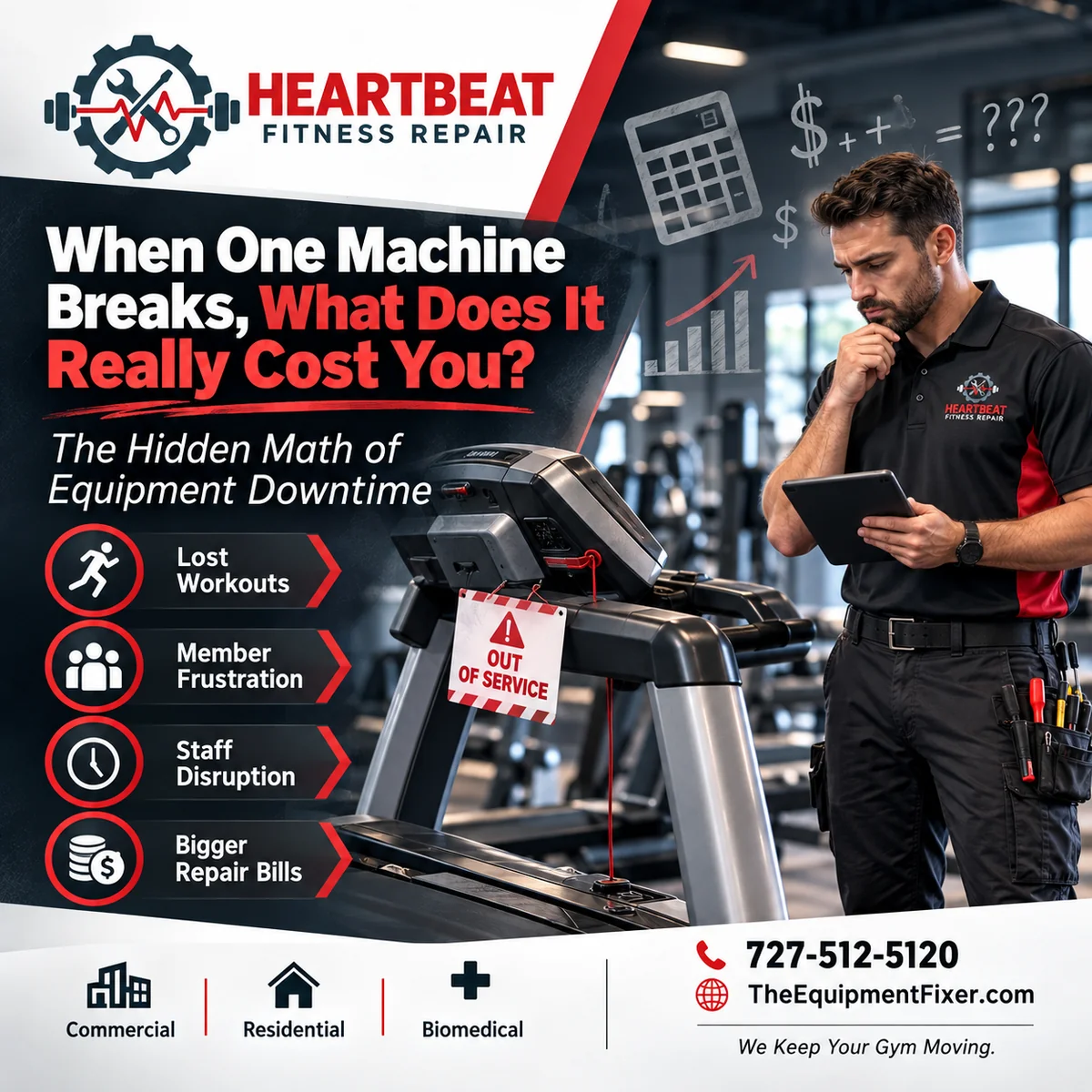
What Does Equipment Downtime Really Cost You?
The repair invoice for a broken machine is only the cost you can see. The real total also includes the days it sits unusable, the members or household routines disrupted around it, the staff time spent managing the problem, and — if the fault was ignored — the larger repair it turned into while it waited. Counting all of it, not just the technician's line item, is what tells you whether you're looking at a $900 problem or a $2,000+ one.
Share: Facebook · LinkedIn · X

When a treadmill, exercise bike, or strength machine stops working, the repair invoice is the easiest cost to see. The harder costs are quieter: members waiting for equipment, staff answering complaints, workouts cut short, and a small mechanical issue turning into a much larger repair. At home, the same problem can quietly turn an expensive machine into a clothes rack.
With more than 19,000 hours spent working on fitness equipment in homes, gyms, healthcare settings, and commercial facilities across Tampa Bay, we've learned that downtime is rarely just a repair problem. It's an availability, safety, budgeting, and customer-experience problem — and most of it never shows up on the invoice.
The Repair Invoice Is Only the Beginning
Say a commercial treadmill needs a belt replacement. You'll get an estimate for parts and labor, but the total cost of that machine being down can also include:
- Days when the treadmill can't be used
- More traffic and waiting around the remaining machines
- Staff time spent responding to complaints
- Rescheduled classes or modified training programs
- Lost day passes or refunds
- Members questioning whether the facility is well maintained
- Additional wear on the equipment that stays in service
- A bigger repair bill if the original fault gets ignored
The repair bill is visible. Everything else lands across different budgets and departments, which is exactly why it's easy to underestimate. The cost of an out-of-service machine should be measured by its effect on the whole operation, not just by the technician's invoice.
What Downtime Costs a Commercial Facility
Reduced capacity and disrupted member behavior. One unavailable machine doesn't sound serious on its own. In a room with ten treadmills, though, one machine down is a 10% reduction in treadmill capacity — and during a busy period, that can create a line almost immediately. Members generally respond in one of three ways: they wait and get frustrated, they switch to a less-preferred machine, or they shorten or skip the workout. A single "out of order" sign is an inconvenience. Several at once can make the whole facility feel neglected — and every machine still occupies floor space, electricity, cleaning, and supervision whether or not it's delivering value to anyone.
Member retention and reputation. Almost nobody cancels and says "I left because the treadmill was broken." It works indirectly — a member's preferred bike is unavailable, the same issue isn't fixed the next week, a cable machine gets taped off, and they start visiting less or looking elsewhere. The cost can eventually show up as a cancellation, a membership freeze, a negative review, fewer referrals, lost personal-training revenue, or a request for a credit. You may never be able to prove one machine caused one cancellation, but repeated equipment problems steadily wear down confidence in a facility. Reliable gym and studio equipment repair is part of protecting the member experience, not just keeping machines running.
Staff labor and administrative time. Someone has to notice the fault, answer questions, label the equipment, contact the manufacturer or service provider, coordinate access, update the equipment log, and explain the situation to members. If a warranty call is delayed or an appointment gets missed, that process starts over. A quick way to estimate it: staff hours spent managing the downtime, multiplied by loaded hourly labor cost, equals the administrative downtime cost. Three employees spending a combined six hours on one equipment problem at $25/hour in loaded cost is another $150 absorbed before the repair even begins.
The Delay Premium: How Small Faults Become Expensive Repairs
Fitness equipment almost always gives warning signs before a major failure: a treadmill belt that starts drifting or slipping, a deck developing a dry or uneven spot, a motor that sounds strained, an exercise bike with inconsistent resistance, a cable starting to fray, a pulley dragging or squeaking, a console that intermittently loses power.
Ignoring those signs sets off a chain reaction. A worn treadmill belt increases friction. Increased friction puts more load on the deck and motor. Continued use can then damage the motor controller or other electronics. The exact progression varies by model, but the pattern is common: a small wear item becomes secondary component damage, which becomes longer downtime, which becomes a much larger repair bill.
There's also a scheduling premium. Planned service can usually be arranged during low-traffic hours, with parts and access prepared in advance. Emergency service often means rushed parts, disrupted schedules, or last-minute changes to how the facility operates. A machine taken offline for a scheduled inspection is a controlled decision. A machine that fails during peak hours is a chain of decisions nobody had time to prepare for.
Safety Is Part of the Cost Calculation
A machine with a worn belt, frayed cable, unstable frame, exposed wiring, or electrical fault shouldn't stay available just because the repair hasn't been scheduled yet. Keeping unsafe equipment in service can expose a commercial facility to user injury, equipment damage, insurance complications, liability claims, reputational harm, and a more serious failure down the line. A clear inspection-and-removal process helps staff make consistent calls: if a concern is identified, label the machine, keep people away from it, document the issue, and schedule qualified service.
If you're checking a machine before service arrives: unplug the equipment first, never open a controller unless you're qualified to do so, and never bypass a safety device. These aren't optional shortcuts. If the fault involves electrical components, internal controllers, damaged wiring, structural instability, or a safety switch, stop and contact a qualified fitness equipment repair professional.
What Downtime Costs at Home
Home gym owners feel a different version of the same problem. There's no lost membership revenue when a treadmill or exercise bike fails, but the owner has still paid for a machine that's no longer delivering the value it was bought to provide. The costs show up as missed workouts and disrupted routines, a machine taking up space without being useful, a growing temptation to give up on home training altogether, the cost of a diagnostic visit or repair, and — if a small fault escalates — the possibility of replacing the whole machine.
A broken machine can quickly become a clothes rack, because every day it stays unrepaired makes restarting the routine less likely. Prompt attention protects both the equipment and the habit built around it. Residential fitness equipment service can tell you quickly whether you're looking at a manageable repair, a maintenance issue, or a sign of a larger component failure.
A Simple Downtime Calculation
You don't need a complex financial model to estimate the impact — just five numbers: repair cost, number of downtime days, the estimated daily value of the machine, staff time and administrative cost, and the potential member or household impact. Here's a straightforward commercial example:
- Repair invoice: $900
- Downtime: 8 days
- Estimated daily operational and member-value impact: $125
- Staff coordination: $200
- Member credits, missed day passes, or other direct adjustments: $150
That works out to $900 + ($125 × 8) + $200 + $150 = $2,250 in estimated total impact. The $900 invoice is real, but in this example it's only 40% of the actual cost. The calculation doesn't need to be exact — its purpose is to make the hidden costs visible so you can compare a reactive repair against planned maintenance on equal footing.
Preventive Maintenance as a Budget Line
Preventive maintenance is easier to defend when it's treated as a predictable operating cost rather than an optional expense. A scheduled visit can catch belt wear, cable fraying, lubrication needs, loose hardware, resistance problems, and developing electrical issues before they become emergency failures — and it creates documentation that's useful for equipment records, future budgeting, and safety decisions.
Our preventive maintenance programs are built around your actual equipment inventory and usage pattern — a commercial gym with heavily used treadmills needs a different schedule than a small residential setup, a hotel fitness room, or a rehabilitation facility. The goal isn't to prevent every repair; no maintenance plan can do that. It's to catch problems earlier, reduce emergency callouts, extend equipment life, make downtime predictable, and protect the experience of the people using the equipment. If one treadmill belt is showing wear, it's often worth checking the others before they reach the same point.
Let Heartbeat Fitness Repair Help You Count It
Reliable fitness equipment supports more than workouts. For a commercial facility, it supports member confidence, staff efficiency, revenue, and reputation. For a homeowner, it supports consistency and the long-term value of the home gym. The best time to calculate downtime is before the next breakdown — review your equipment inventory, identify your most heavily used machines, track how long repairs typically take, and estimate the cost of taking each one offline.
With more than 19,000 hours of on-site expertise and over 5,000 pieces of equipment repaired, Heartbeat Fitness Repair helps residential owners and commercial facilities keep equipment safer, more dependable, and available when people need it. When a machine is showing warning signs, or downtime is already affecting your operation, schedule service online or request a facility quote — a small, planned investment today can prevent a much larger cost tomorrow.
Frequently Asked Questions
- Why does one broken machine cost more than just the repair bill?
- A repair invoice only covers parts and labor. It doesn't capture the days a machine sits unusable, the members who wait or switch equipment, the staff time spent fielding complaints and coordinating service, or the extra wear placed on the machines that stay in use while one is down. For a commercial facility those costs land in different budgets, which is exactly why they're easy to underestimate until you add them up.
- Can one out-of-service machine really affect member retention?
- Yes, though it rarely shows up as a single clear cause. A member finds their preferred bike or treadmill unavailable, the same issue isn't fixed the next week, and they gradually shift their routine, visit less often, or start looking elsewhere. It's hard to trace one cancellation to one broken machine, but repeated equipment problems steadily erode the confidence members have in a facility being well maintained.
- Why does waiting to fix a small issue make the repair more expensive?
- Fitness equipment usually gives warning signs before it fails outright — a drifting treadmill belt, a motor that sounds strained, an exercise bike with inconsistent resistance, a fraying cable. Ignored long enough, a small wear item creates extra load on the parts around it, and what started as a belt or cable replacement can escalate into a motor, controller, or frame-level repair. Planned service is also cheaper to schedule than an emergency callout, since parts and access can be arranged in advance instead of rushed.
- Should equipment with a safety issue stay in service until a technician arrives?
- No. A machine with a worn belt, frayed cable, unstable frame, exposed wiring, or electrical fault should be taken out of service immediately, not left running until a repair slot opens up. Label it, keep people away from it, document the issue, and schedule a qualified technician. Never open a controller unless you're qualified to do so, and never bypass a safety device to keep a machine available.
- Does downtime cost home gym owners the same way it costs a commercial facility?
- The mechanics are different but the pattern is similar. There's no lost membership revenue at home, but the owner has still paid for a machine that isn't delivering value, and every day it sits broken makes it easier to lose the workout habit built around it — a treadmill left unrepaired can quietly become a clothes rack. Prompt diagnosis protects both the equipment and the routine, which is why residential fitness equipment service is worth calling before a minor fault turns into a bigger one.
Related Services in Tampa Bay
- Preventive Maintenance in Tampa, FL
- Preventive Maintenance in Clearwater, FL
- Preventive Maintenance in St. Petersburg, FL
- Preventive Maintenance in Brandon, FL
- Preventive Maintenance in Sarasota, FL
- All Preventive Maintenance Service Areas
- Schedule a Repair — Same-Week Appointments Available
Fitness Equipment Repair and Maintenance Throughout Tampa Bay
- Preventive Maintenance Plans — Catch Problems Before They're Costly
- Commercial Gym Equipment Repair Programs
- Treadmill Repair Service Areas
- Exercise Bike Repair Service Areas
- Elliptical Repair Service Areas
- Schedule a Repair — Same-Week Appointments Available
Need Fitness Equipment Repair in Tampa Bay?
Heartbeat Fitness Repair provides on-site diagnostics and repair for treadmills, exercise bikes, ellipticals, and strength equipment throughout Pinellas, Hillsborough, Manatee, Sarasota, and Pasco counties. Factory-trained technicians. Written quotes before any work begins. Same-week scheduling.
Call 727-512-5120 — Monday–Friday 5 AM–7 PM, Saturday 7 AM–2 PM — or book a repair online.
Written Quote Before Any Work Begins
Prices shown are starting estimates — actual cost varies by brand, model, and parts availability. We always provide an exact written quote before we touch your machine, so there are no surprises on the invoice. We’re also an authorized warranty repair provider for many major manufacturers. Call 727-512-5120 for pricing on your specific unit.