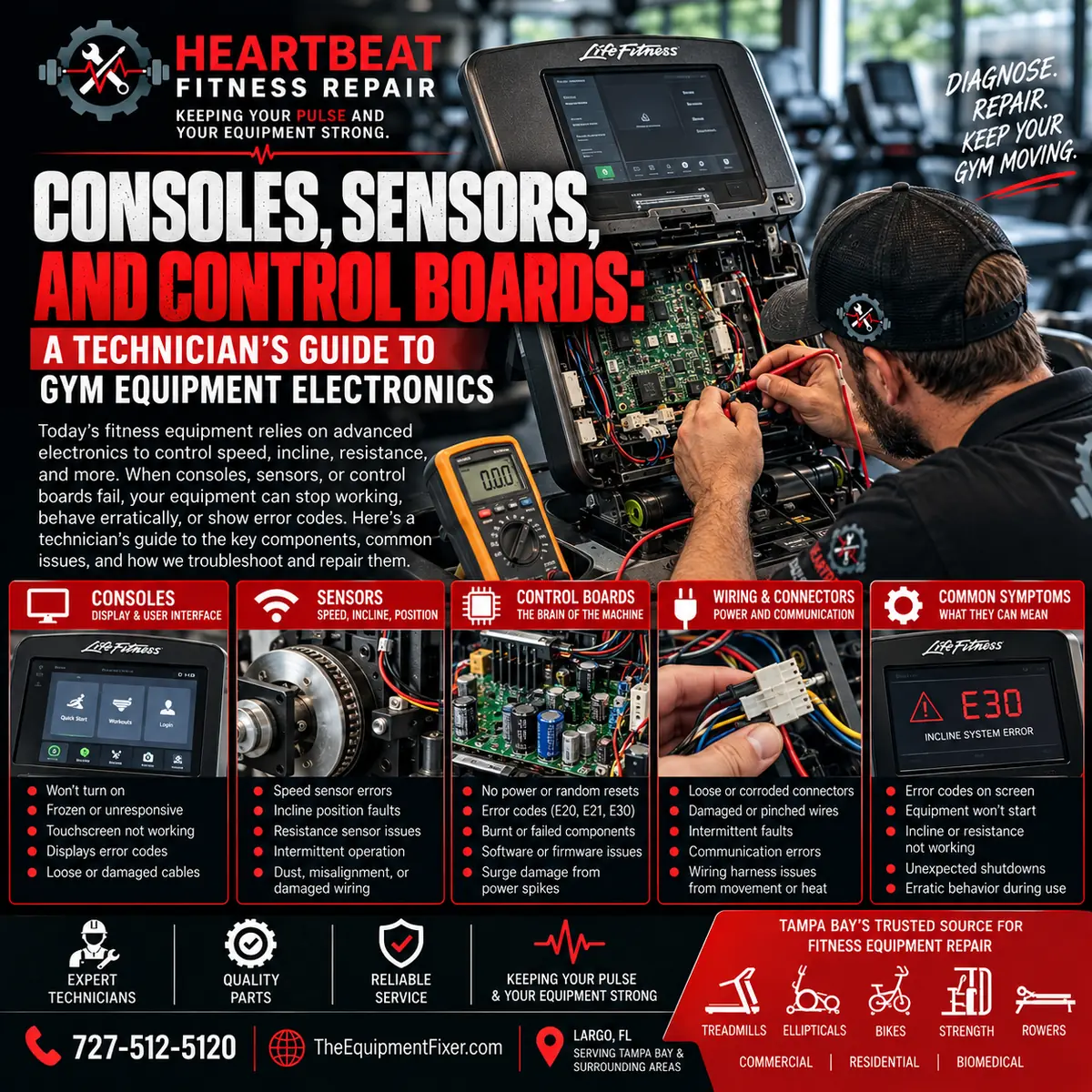
Consoles, Sensors, and Control Boards: A Technician's Guide to Gym Equipment Electronics
A blank console, a phantom error code, or resistance and incline readings that don't match reality are rarely a simple "replace the console" fix — they're usually the visible symptom of a fault somewhere in the wiring, a sensor, or the lower control board that feeds it. Tracing the problem back through those layers, rather than swapping the most obvious part, is what separates a lasting repair from an expensive guess.
Share: Facebook · LinkedIn · X

Modern fitness equipment is part machine and part computer. A treadmill can have a healthy motor and a perfectly tracked belt and still appear completely dead — because a console cable worked loose. An exercise bike can pedal smoothly while its resistance or heart-rate readings drift into nonsense. An elliptical can feel mechanically sound while a single sensor stops the console from registering movement at all.
With more than 19,000 hours diagnosing equipment in homes, gyms, healthcare facilities, and commercial fitness centers across Tampa Bay, we've learned that electronic problems are almost always solved in layers: power first, then wiring and sensors, then control boards and consoles. Skip a layer, and you risk paying to replace a part that was never the actual problem.
This guide walks through what you can safely check yourself, and where the line is for professional fitness equipment repair.
Start With the Console — But Don't Stop There
A blank or glitching screen feels like a console problem, but the console is often just the messenger. It can go dark because of a tripped breaker, a loose console cable, a failed lower control board, a damaged ribbon or keypad connection, a software or firmware fault, or a failed display panel itself.
If the machine is completely unresponsive, check first whether the power switch or indicator light comes on. If the machine has power but the screen stays blank, the fault is more likely between the lower control board and the console than with the screen. A flickering display usually points to an unstable connection, a damaged cable, a power fluctuation, or a failing board. Unresponsive buttons or touchscreens can come from a worn membrane keypad, contamination around the screen, a software freeze, or a damaged input board.
Dead pixels are a display-panel problem. Calibration drift is different — the screen works, but touch selections land away from where you press, or the incline, resistance, speed, or distance readings don't match what the equipment is actually doing. A machine can be mechanically fine and still read as electronically "dead" because the console isn't receiving the low-voltage power or communication signal it needs from the electronics below it.
The Control Board: Reading the Error, Not Just Reacting to It
The lower control board — often called a motor controller or motor control board — connects the machine's power and movement systems. On a treadmill, it can regulate motor speed, read speed-sensor feedback, communicate with the console, and manage incline. On other equipment, it may control resistance, movement feedback, or electronic braking.
When the board detects something outside its expected range, it throws an error code. That code is a useful clue — not always a final diagnosis. A speed-related error, for example, could be caused by a misaligned or failed speed sensor, a damaged sensor cable, a loose connector, a slipping belt or drive component, a failed sensor input on the board, or a genuine motor problem. The same code, several possible causes.
Surges, inadequate power, moisture, dust buildup, overheating, and normal wear can all contribute to a board failing. A breaker that trips repeatedly should never just get reset and ignored — it can mean an overloaded circuit, damaged wiring, a short, or a fault inside the equipment. Replacing a board without finding the root cause is one of the most expensive mistakes we see: if a shorted motor, damaged cable, or failing sensor is still in the system, it can take out the replacement board too. Proper treadmill repair means testing the surrounding components before recommending a board replacement, not swapping the board and hoping.
Sensors Cause the "Strange" Problems
Sensors are how the equipment checks its own work — comparing what it's told to do against what's actually happening. When a sensor signal goes weak or intermittent, the equipment can behave in ways that look completely unrelated to the real cause.
Speed sensors and reed switches. Treadmills commonly use magnetic, Hall-effect, or optical sensors to measure roller or motor movement. If the sensor is loose, dirty, misaligned, or too far from its target, the console can show an error even though the belt is moving fine. A treadmill that starts and then stops is often losing speed feedback, not losing power — and a damaged wire can create the same symptom, especially when vibration causes the connection to open only intermittently.
Incline position sensors. Incline systems use position sensors to tell the controller where the lift mechanism actually is. If the machine can't confirm its position, it may refuse to move, stop short of the selected elevation, or throw an incline error. Never force an incline mechanism by hand — if it's stuck elevated or keeps trying to recalibrate, unplug it and schedule service.
Heart-rate contacts and receivers. Hand-grip contacts produce false or missing readings when they're dirty, wet, corroded, or not held consistently. Chest-strap receivers can also be thrown off by a depleted transmitter battery, a pairing conflict, or interference. A heart-rate reading that jumps dramatically doesn't necessarily mean the console is defective — clean the contact surfaces per the manufacturer's instructions, confirm the strap battery, and test with a known-compatible transmitter before assuming the worst.
Safety keys and emergency stops. A treadmill that refuses to start, or stops unexpectedly, when its safety key or emergency-stop circuit isn't detected correctly is doing exactly what it's designed to do. Never bypass a safety key or emergency stop to make the equipment run — these exist to protect the person using it.
Rule Out the Simple Things First
Before assuming an electronic component has failed, check the basics of the power path:
- The wall outlet actually works.
- The machine's power switch is fully engaged.
- The power cord isn't cut, pinched, loose, or warm to the touch.
- The machine's reset or circuit breaker hasn't tripped.
- Console and sensor connectors are fully seated.
- Wires aren't pinched under covers or rubbing against moving parts.
Dust restricts cooling and settles on connections. Humidity or liquid exposure can contribute to corrosion over time — equipment kept in damp areas, near open doors, or where cleaning spray reaches the console can develop intermittent electronic faults that show up months later. Use the power arrangement the manufacturer specifies, avoid extension cords unless explicitly permitted, and never keep running equipment that's tripping a breaker.
When the Problem Is the Connection, Not the Machine
Modern equipment often communicates with phones, watches, chest straps, and apps over Bluetooth, ANT+, or Wi-Fi. When these features fail, the machine itself may be working correctly. Before assuming a hardware fault, try confirming the wireless connection is enabled, forgetting and re-pairing the device, checking the sensor or chest-strap battery, making sure another device isn't already connected, restarting both the equipment and the mobile device, confirming the console software and app are current, checking for a known outage, and moving away from likely sources of interference.
Firmware updates can fix bugs, improve compatibility, or change how sensors and controllers talk to each other — but an incorrect or interrupted update can create a more serious problem than the one it was meant to fix. Only install updates through the manufacturer's official process, and never attempt to flash a board without understanding the exact procedure.
A Safe Self-Check, Before You Call
- Stop using the equipment if it's behaving unsafely, and unplug it before touching any cable or connector.
- Record the exact symptom — a blank screen, the machine stopping, a reading jumping, or a specific error code.
- Power-cycle the equipment: off, unplugged, wait several minutes, then reconnect.
- Check the outlet, cord, switch, breaker, and safety key.
- Inspect accessible cables and connectors for looseness, damage, corrosion, or pinching.
- Clean accessible contacts as the manufacturer directs — never spray liquid into a console.
- Look up the exact error code in the owner's manual.
- Check for official firmware and app updates.
- Document what changed — a photo of the error code, the time it occurred, and what the machine was doing helps a technician diagnose it faster.
Stop and schedule gym equipment repair if the breaker trips again, the equipment smells hot or burnt, wiring is visibly damaged, the machine stops under load, or the same error keeps returning after a reset. Never open a power supply or controller unless you're qualified to work safely around electrical components — internal parts can hold dangerous voltage even after the machine is unplugged. Never test exposed electronics around moving belts, rollers, motors, or incline mechanisms unless you have the training and equipment to do it safely.
Why Intermittent Faults Are the Hardest to Chase
A complete failure is usually easier to diagnose than a problem that only appears occasionally. Vibration, heat, moisture, and movement can make a weak connector work one moment and fail the next — a cable can test fine while stationary but open up once the machine is moving, and a sensor can work when cold and fail after several minutes of use.
That's why documentation matters. Recording the exact error code, when it appears, the speed or resistance at the time, whether a connected device was in use, and whether cycling power temporarily fixes it gives a technician a real diagnosis to work from instead of a guess. For commercial facilities, the same discipline applied across an entire equipment inventory — console diagnostics, sensor checks, calibration, and wiring inspection on a preventive schedule — is what keeps a minor fault from turning into downtime. Our commercial service and preventive maintenance programs are built around exactly that.
Let Heartbeat Fitness Repair Trace It Down
A careful first check resolves plenty of loose connections and software hiccups on its own. When the problem involves a tripping breaker, a control board, a safety circuit, motor behavior, or wiring you can't see, professional diagnosis is the safer and ultimately cheaper path.
Whether it's a treadmill console gone dark, an exercise bike with erratic resistance, or an elliptical throwing sensor errors, Heartbeat Fitness Repair traces the fault back to its real cause — not just the part that happens to be easiest to swap. Schedule service to get your equipment, and your routine, moving again with confidence.
Frequently Asked Questions
- Why is my treadmill or exercise bike console blank even though the machine has power?
- A console can stay blank even with power reaching the machine if there's a loose console cable, a failed lower control board, a damaged ribbon connection, a firmware fault, or a failed display panel. If the power indicator or switch comes on but the screen stays dark, the fault is usually between the lower board and the console rather than the screen itself, and a technician needs to test that path before replacing any single part.
- Does an error code always mean the control board has failed?
- No. An error code is a clue, not a diagnosis. A speed-related error, for example, can be caused by a misaligned speed sensor, a damaged sensor cable, a loose connector, a slipping belt, or an actual control-board fault — the same code can point to several different root causes. Replacing the board without ruling out the surrounding wiring and sensors first can waste money, and if a shorted motor or bad sensor caused the original failure, it can damage the replacement board too.
- Can a sensor problem make equipment behave erratically without any visible damage?
- Yes. Sensors let the equipment compare what it's told to do against what's actually happening, and a loose, dirty, or misaligned sensor produces symptoms that look unrelated to the real cause — a treadmill that starts and stops, an incline that refuses to move or throws an error, or heart-rate readings that jump for no reason. These faults often come and go with vibration or movement, which is why they can be hard to reproduce during a quick inspection.
- My equipment won't connect to my phone or app — is that a hardware failure?
- Usually not. Bluetooth, ANT+, and Wi-Fi connection issues are commonly caused by another device already paired, a depleted chest-strap or sensor battery, outdated console or app firmware, or a service outage — not a hardware fault in the machine. Re-pairing the device, checking the strap battery, restarting both devices, and confirming the app and firmware are current usually resolves it before any technician visit is needed.
- When should I stop using equipment and call for professional repair instead of troubleshooting it myself?
- Stop using the equipment and schedule service if a breaker trips repeatedly, you notice a burning smell, wiring looks damaged, the machine stops under load, or the same error code keeps returning after a reset. Never open a power supply or controller yourself — internal components can hold dangerous voltage even after the machine is unplugged — and never bypass a safety key or emergency stop to keep equipment running.
Related Services in Tampa Bay
- Preventive Maintenance in Tampa, FL
- Preventive Maintenance in Clearwater, FL
- Preventive Maintenance in St. Petersburg, FL
- Preventive Maintenance in Brandon, FL
- Preventive Maintenance in Sarasota, FL
- All Preventive Maintenance Service Areas
- Schedule a Repair — Same-Week Appointments Available
Fitness Equipment Diagnostics and Repair Throughout Tampa Bay
- Treadmill Repair Service Areas
- Exercise Bike Repair Service Areas
- Elliptical Repair Service Areas
- Strength Equipment Repair Service Areas
- Preventive Maintenance Plans — Catch Electronic Faults Before They're Repairs
- Schedule a Repair — Same-Week Appointments Available
Need Fitness Equipment Repair in Tampa Bay?
Heartbeat Fitness Repair provides on-site diagnostics and repair for treadmills, exercise bikes, ellipticals, and strength equipment throughout Pinellas, Hillsborough, Manatee, Sarasota, and Pasco counties. Factory-trained technicians. Written quotes before any work begins. Same-week scheduling.
Call 727-512-5120 — Monday–Friday 5 AM–7 PM, Saturday 7 AM–2 PM — or book a repair online.
Written Quote Before Any Work Begins
Prices shown are starting estimates — actual cost varies by brand, model, and parts availability. We always provide an exact written quote before we touch your machine, so there are no surprises on the invoice. We’re also an authorized warranty repair provider for many major manufacturers. Call 727-512-5120 for pricing on your specific unit.