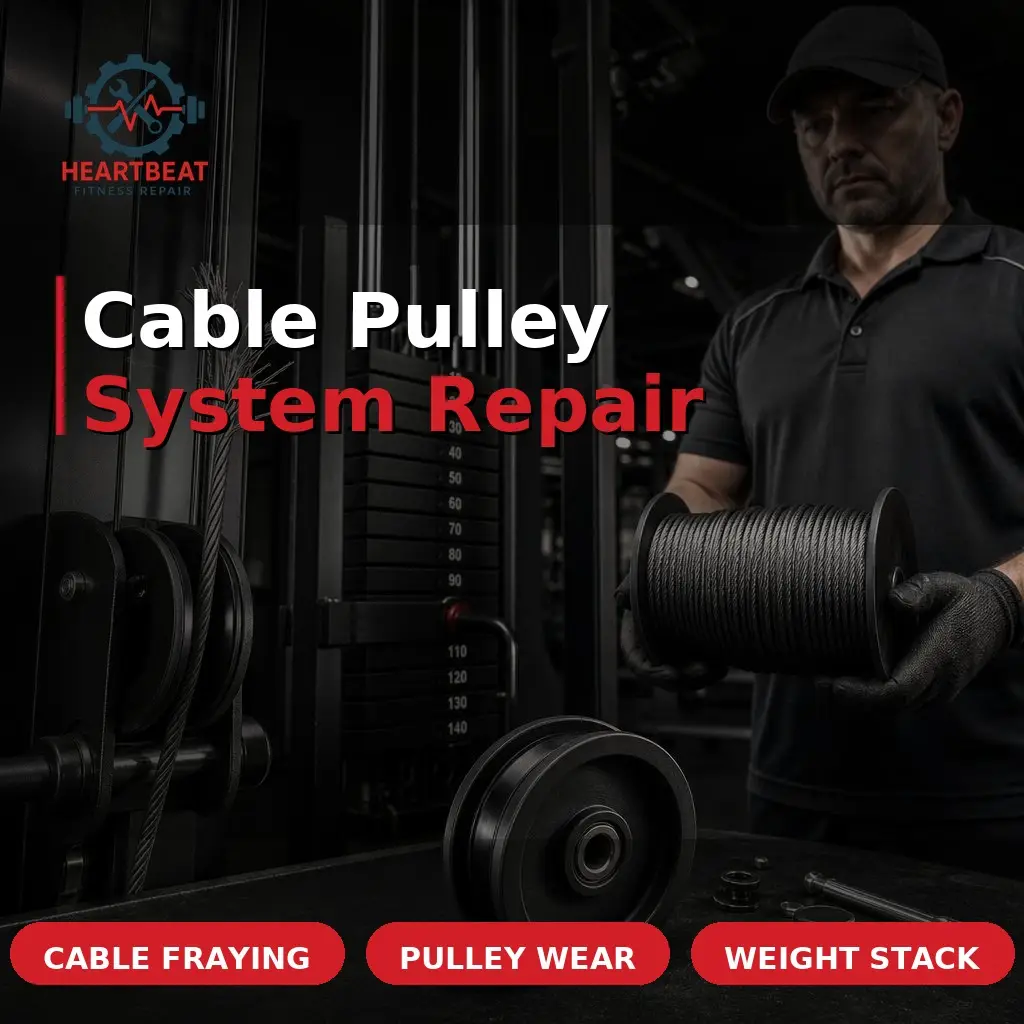
Cable Pulley System Repair: What's Wrong and How to Fix It
Strength machine cables fray and eventually snap due to age and use cycles, kinking at a sharp bend point where the cable enters a pulley housing, rust or corrosion weakening the cable strands, or a misaligned pulley causing uneven wear on one side of the cable.
Share: Facebook · LinkedIn · X

The cable pulley system is the central nervous system of most cable machines — functional trainers, cable crossovers, lat pulldown stations, and all-in-one home gyms. When something goes wrong in that system, the machine becomes unusable or unsafe. We handle strength equipment repairs throughout Tampa Bay, and cable and pulley failures are among the most frequent strength equipment calls we receive.
The Anatomy of a Cable Pulley System
Cable (wire rope): Galvanized or stainless steel wire rope, typically 3/16" or 1/4" diameter, running from the weight stack through pulleys to the handle attachment.
Pulleys: Grooved wheels with sealed bearings that redirect the cable and reduce friction. The number of pulleys determines the system's mechanical advantage.
Cable guides and tubes: UHMW plastic guides or metal tubes that protect the cable at corners and frame contact points.
Weight stack and selector pin: The selectorized weight stack uses a pin to engage specific plates; the cable attaches to the carriage above the selected plate.
Cable ends (ferrules/swaged ends): Terminations that anchor the cable at the weight stack and attachment point.
Problem 1: Frayed or Broken Cable
Never use a machine with a visibly frayed cable. A cable carrying a 200 lb weight stack stores significant energy — a break can cause serious injury. Signs of cable wear: visible broken strands (especially near the ends where stress concentrates), kinking that won't straighten, rust or dark discoloration, or a snapping sound during use. Cable replacement is one of the most common repairs we perform. Replacement typically costs $160–$299 depending on cable length and routing complexity.
Problem 2: Grinding or Squeaking Pulleys
When a pulley's bearing wears out or the grooved surface becomes damaged, you'll hear grinding, squeaking, or rhythmic clicking as the cable moves. A worn pulley also creates uneven friction — the weight stack feels heavier on some portions of the movement, lighter on others. Inspect each pulley by spinning it by hand with the cable slack or removed. A good pulley spins freely and silently. A worn pulley will feel rough or gritty. Pulley replacement costs $99–$199 per pulley.
Problem 3: Cable Jumping Off the Pulleys
Common causes: a worn pulley groove that's too wide to keep the cable centered; cable stretch that changes the approach angle to the pulley; or a misaligned pulley mount (loosened frame bracket or bent pulley arm, common on home gym units). A cable that has derailed must be reseated correctly before use — an improperly seated cable will derail again under load.
Problem 4: Sticky or Jammed Weight Stack
A weight stack that sticks or moves inconsistently is often a lubrication problem. The weight stack rides on guide rods that require periodic lubrication — dry guide rods create friction that makes the stack feel heavier than it should and can cause it to bind. Apply a light coat of dry PTFE or silicone spray to the guide rods (not the cable). Avoid oil-based lubricants that attract dust and create gummy buildup. If the stack continues to bind after lubrication, a plate may be warped or the guide rods bent — common on older commercial machines with heavy use.
Problem 5: Worn or Broken Cable Guide Tubes
UHMW plastic cable guides protect the cable and frame at corners. When these guides wear through, the cable contacts bare metal, dramatically accelerating cable fraying. Worn guides often produce a scraping or grinding sound at a specific point in the movement — unlike pulley noise, the location doesn't change with cable speed.
Preventive Maintenance for Cable Machines
Home users: inspect cables visually every 3–6 months for fraying, and lubricate weight stack guide rods annually with dry PTFE spray. Commercial facilities: cable inspection should be part of every quarterly service visit, with replacement at the first sign of strand breakage — not when the cable fails. Our preventive maintenance service covers cable inspection, pulley checks, guide rod lubrication, and hardware tightening.
When to Call a Technician
Call us immediately if the cable has any visible broken strands. Also call when the cable has jumped off a pulley and you can't safely reseat it, when grinding pulleys don't improve with cleaning, when the weight stack binds suggesting a bent guide rod, or when you need a full cable routed through multiple pulleys and guides. We service Life Fitness, Precor, Matrix, Cybex, Body-Solid, Inspire Fitness, and other major brands throughout Tampa, Clearwater, and all of Tampa Bay. Call 727-512-5120 for same-week scheduling.
How Much Does Cable Machine Repair Cost?
Our diagnostic fee is $149.99–$169.99 (residential & commercial). Guide rod lubrication is $99 standalone or included in the diagnostic visit. All other repair costs depend on the brand, model, and whether the unit is commercial or residential — we provide a written quote after an on-site diagnosis before any work begins. See our pricing page for more detail.
Frequently Asked Questions
- What causes a strength machine cable to fray or snap?
- Strength machine cables fray and eventually snap due to age and use cycles, kinking at a sharp bend point where the cable enters a pulley housing, rust or corrosion weakening the cable strands, or a misaligned pulley causing uneven wear on one side of the cable. A cable under heavy commercial use may need replacement every 1–3 years; home gym cables commonly last 5–10 years. Regular inspection catches fraying before it becomes a snap. Call 727-512-5120.
- Is it safe to use a cable machine with a frayed cable?
- No — a frayed cable is a safety hazard and should be taken out of service immediately. A cable that has visible broken strands has already lost significant tensile strength. Under load, a frayed cable can snap without warning, causing the weight stack to drop freely and creating a serious injury risk. Immediate inspection and replacement is the right call — not continued use. Call 727-512-5120 for a same-week repair.
- How much does cable machine repair cost in Tampa Bay?
- Our service call fee is $149.99–$169.99 (residential & commercial) depending on your location. Replacement cables themselves vary by length and machine type — total cost depends on cable count, routing complexity, brand, and model. We stock cables for Life Fitness, Precor, Matrix, Cybex, and other major brands. We provide a full written quote after diagnosis before any work begins. Call 727-512-5120.
- Can I replace a cable machine cable myself?
- Cable replacement is technically possible as a DIY repair but carries significant risks if not done correctly. The cable must be routed through the correct pulley path, crimped properly at both ends, and tensioned correctly for safe use. An improperly crimped cable can slip out of its ferrule under load — equivalent to a snapped cable. For commercial facilities especially, professional cable replacement is the right call for liability and safety reasons. Call 727-512-5120.
- How often should cable machine cables be inspected?
- Professional inspection every 6–12 months is recommended for home gym cable machines; every 3–6 months for commercial or high-use machines. During inspection, look for fraying at the pulley entry points, kinking or stiffening of the cable, rust discoloration on the strands, or changes in how smoothly the cable travels. We include cable inspection as part of any strength equipment service call. Call 727-512-5120.
Related Services in Tampa Bay
- Strength Equipment Repair in Tampa, FL
- Strength Equipment Repair in Clearwater, FL
- Strength Equipment Repair in St. Petersburg, FL
- Strength Equipment Repair in Brandon, FL
- Strength Equipment Repair in Sarasota, FL
- All Strength Equipment Repair Service Areas
- Schedule a Repair — Same-Week Appointments Available
Related Strength Equipment Repair Services in Tampa Bay
- Strength Equipment Repair in Tampa, FL
- Strength Equipment Repair in Clearwater, FL
- Strength Equipment Repair in St. Petersburg, FL
- All Strength Equipment Repair Service Areas
- Schedule a Repair — Same-Week Appointments Available
Need Fitness Equipment Repair in Tampa Bay?
Heartbeat Fitness Repair provides on-site repair for treadmills, ellipticals, exercise bikes, rowing machines, stair climbers, and strength equipment throughout Pinellas, Hillsborough, Manatee, Sarasota, and Pasco counties. Factory-trained technicians. Same-week scheduling. No haul-away required.
Call 727-512-5120 — Monday–Friday 5 AM–7 PM, Saturday 7 AM–2 PM — or book a repair online.
Written Quote Before Any Work Begins
Prices shown are starting estimates — actual cost varies by brand, model, and parts availability. We always provide an exact written quote before we touch your machine, so there are no surprises on the invoice. We’re also an authorized warranty repair provider for many major manufacturers. Call 727-512-5120 for pricing on your specific unit.