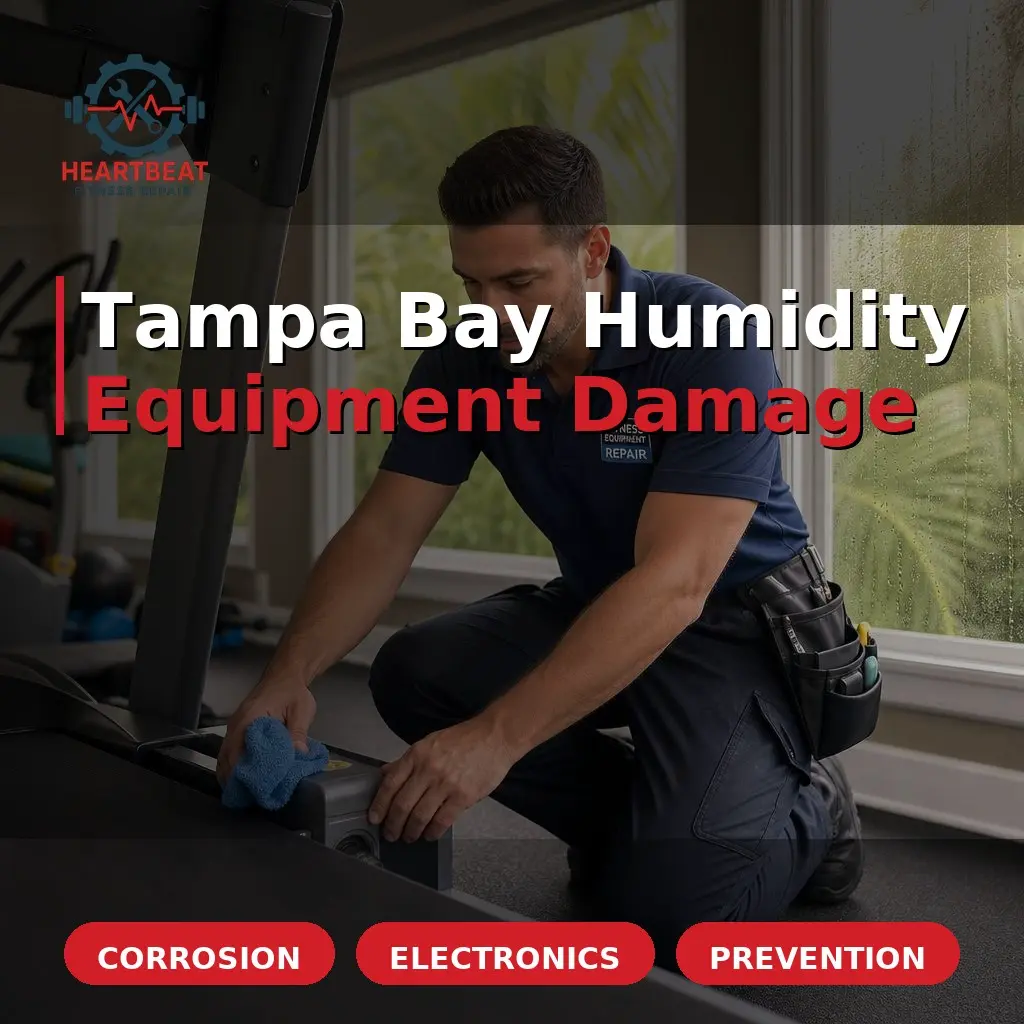
Tampa Bay Humidity and Heat: How They Damage Fitness Equipment (And How to Protect It)
Humidity is one of the leading causes of premature fitness equipment failure in Tampa Bay. Moisture in the air accelerates corrosion on unpainted metal hardware (bolts, guide rods, weight stack pins), causes rust to form inside motor housings, and can lead to condensation on circuit boards inside consoles, which shorts electronics over time.
Share: Facebook · LinkedIn · X

Tampa Bay's climate is hard on fitness equipment in a way that most owners never connect to the actual failure they're dealing with. It's rarely a single dramatic event — it's a slow, year-round process of humidity and heat working on metal, electronics, and rubber components until something finally gives out. By the time a customer calls us about a rusted guide rod or a console that won't power on, the damage has usually been building for months.
We service equipment across every kind of space in Tampa Bay — air-conditioned home gyms, garages, lanais, condo fitness rooms, and commercial facilities — and the difference in wear between a climate-controlled room and a humid, un-air-conditioned space is one of the clearest patterns we see. Here's what's actually happening, and what you can do about it.
Why Humidity Is Harder on Equipment Than People Realize
Florida's Gulf Coast humidity regularly sits above 80% for much of the year, and that moisture doesn't stay outside. It works its way into garages, lanais, and even air-conditioned rooms whenever doors and windows open. Unlike a dry climate where metal stays dry and stable, Tampa Bay equipment is in a near-constant low-grade battle against oxidation.
- Corrosion on exposed metal — weight stack guide rods, cable pulley pins, treadmill frame bolts, and elliptical stride axles are typically unpainted steel or chrome-plated. Humidity accelerates surface rust, which increases friction and wears bushings and bearings faster.
- Condensation inside electronics — when temperature swings between a warm day and a cooler air-conditioned night, moisture in the air can condense on the inside surfaces of a console housing. Over repeated cycles, that moisture corrodes ribbon connectors and circuit board contacts.
- Faster rubber and belt degradation — heat and humidity cycling dries out and cracks rubber grips, hand-pulse sensors, and belt materials faster than in a stable, dry environment.
- Salt air near the coast — for equipment in homes and facilities closer to the water, airborne salt combines with humidity to corrode metal even faster than humidity alone.
The Riskiest Locations: Garages, Lanais, and Un-Air-Conditioned Rooms
Where you put your equipment matters as much as how you use it. We see the fastest deterioration in three types of spaces:
- Garages — minimal airflow, no climate control, and direct exposure to whatever the outside air is doing. A garage in July can swing between a humid 95°F afternoon and a cooler, still-humid night, which is exactly the temperature-swing pattern that drives condensation inside consoles.
- Lanais and screened porches — better airflow than a garage, but still fully exposed to ambient humidity with no dehumidification. Salt air exposure is also higher for coastal properties.
- Rooms with the AC habitually turned off or set high — a spare bedroom or bonus room that isn't consistently cooled behaves more like a garage than a conditioned space, especially with the door closed and no airflow.
None of this means you can't keep equipment in these spaces — plenty of Tampa Bay homes do. It means the maintenance interval needs to be shorter, and a few environmental changes make a real difference.
What Humidity Damage Actually Looks Like
Watch for these early warning signs — they're all cheaper to address before they progress:
- Surface rust or discoloration on guide rods, pulley pins, or frame hardware
- A weight stack that feels gritty, sticky, or louder than usual moving up and down
- Console buttons that are unresponsive, intermittent, or an error code that appears only sometimes
- A musty smell coming from the console housing or motor hood
- Rubber grips or hand-pulse sensors that feel cracked, tacky, or brittle
- A treadmill belt that dries out and needs lubrication more often than the standard 3–6 month interval
How to Protect Equipment From Tampa Bay's Climate
1. Control the Environment When You Can
A dehumidifier in a garage or lanai gym space is one of the highest-value additions you can make — it directly addresses the root cause rather than just treating symptoms. Even a portable unit set to keep relative humidity under 60% meaningfully slows corrosion. Basic airflow from a fan also helps prevent the still, damp air that condensation needs.
2. Wipe Down Metal Hardware Regularly
A dry microfiber cloth run across exposed guide rods, pulley pins, and frame hardware after humid days removes surface moisture before it has a chance to oxidize. This takes under a minute and is the single easiest thing an owner can do.
3. Increase Lubrication Frequency
In a non-climate-controlled space, we recommend lubricating treadmill decks and cable systems more often than the standard interval — every 2–3 months instead of 3–6. Humidity dries out lubricant faster and increases the friction that leads to belt slipping and cable wear.
4. Protect the Console When Not in Use
A simple cover over the console during periods of non-use — especially overnight in a garage — reduces the amount of condensation that can form directly on sensitive electronics.
5. Shorten Your Maintenance Interval
This is the change that matters most. Equipment in an air-conditioned room can typically follow the standard 6-month preventive maintenance schedule. Equipment in a garage, lanai, or inconsistently cooled space should be inspected every 3–4 months so hardware corrosion and early electrical issues get caught while they're still an inexpensive fix.
When to Call a Technician
Reach out if you notice:
- Visible rust or corrosion on any moving hardware
- A console with intermittent power, unresponsive buttons, or new error codes
- Increased noise or grittiness from a weight stack, pulley system, or motor
- A belt that seems to dry out or slip faster than it used to
- Any equipment that's been in a garage or lanai for more than a year without a professional inspection
We service home gyms, commercial facilities, and equipment in every kind of space across Tampa Bay — including treadmills, ellipticals, exercise bikes, and strength equipment — throughout Tampa, Clearwater, St. Petersburg, and all surrounding areas. If your equipment lives in a garage, lanai, or un-air-conditioned space, ask us about a shortened preventive maintenance schedule built for our climate. Call 727-512-5120 or schedule online for same-week appointments.
Frequently Asked Questions
- Does Florida humidity really damage fitness equipment?
- Yes — humidity is one of the leading causes of premature fitness equipment failure in Tampa Bay. Moisture in the air accelerates corrosion on unpainted metal hardware (bolts, guide rods, weight stack pins), causes rust to form inside motor housings, and can lead to condensation on circuit boards inside consoles, which shorts electronics over time. Homes and gyms without consistent air conditioning or dehumidification see this damage fastest. Call 727-512-5120 if you notice rust, sticking mechanisms, or console glitches.
- Which parts of a treadmill or elliptical are most affected by humidity?
- Exposed metal hardware is most at risk — weight stack guide rods, cable pulley pins, treadmill frame bolts, and elliptical stride axles all corrode faster in humid air, especially in garages, lanais, and un-air-conditioned Florida rooms. Console electronics are the second major risk: humidity that condenses inside a console housing (common with large day-to-night temperature swings) can corrode internal contacts and cause intermittent power or button failures. Belts and grips also dry out and crack faster under repeated heat-humidity cycling.
- Is it bad to keep gym equipment in a garage or lanai in Tampa Bay?
- It's one of the toughest environments for fitness equipment in our climate. Garages and lanais see the widest daily temperature and humidity swings, minimal air circulation, and often direct exposure to salt air near the coast — a combination that accelerates corrosion, warps plastic housings, and shortens motor and console life significantly compared to an air-conditioned room. If a garage or lanai setup is your only option, a dehumidifier, a fan for airflow, and more frequent maintenance intervals make a real difference.
- How often should equipment be serviced in a humid climate like Tampa Bay?
- We recommend preventive maintenance every 3–4 months for equipment kept in non-climate-controlled spaces (garages, lanais, un-air-conditioned rooms) in Tampa Bay, versus the standard 6-month interval for equipment in fully air-conditioned rooms. More frequent lubrication of belts and decks, hardware inspection for early corrosion, and console housing checks catch humidity-related damage while it's still a low-cost fix rather than a full component replacement.
- Can humidity damage cause an error code or console failure?
- Yes — this is one of the more common calls we get after Tampa Bay's summer humidity spikes. Moisture that gets into a console housing, either from ambient humidity condensing overnight or from sweat and cleaning liquids, can corrode internal ribbon connectors and circuit board contacts, producing intermittent error codes, unresponsive buttons, or a console that won't power on at all. If you're seeing new error codes after a stretch of high humidity, a technician can inspect and clean the internal contacts before full corrosion forces a console replacement. Call 727-512-5120.
Written Quote Before Any Work Begins
Prices shown are starting estimates — actual cost varies by brand, model, and parts availability. We always provide an exact written quote before we touch your machine, so there are no surprises on the invoice. We’re also an authorized warranty repair provider for many major manufacturers. Call 727-512-5120 for pricing on your specific unit.